


June Portfolio Update: Why a $24,000 Drop Didn't Change My Income Strategy
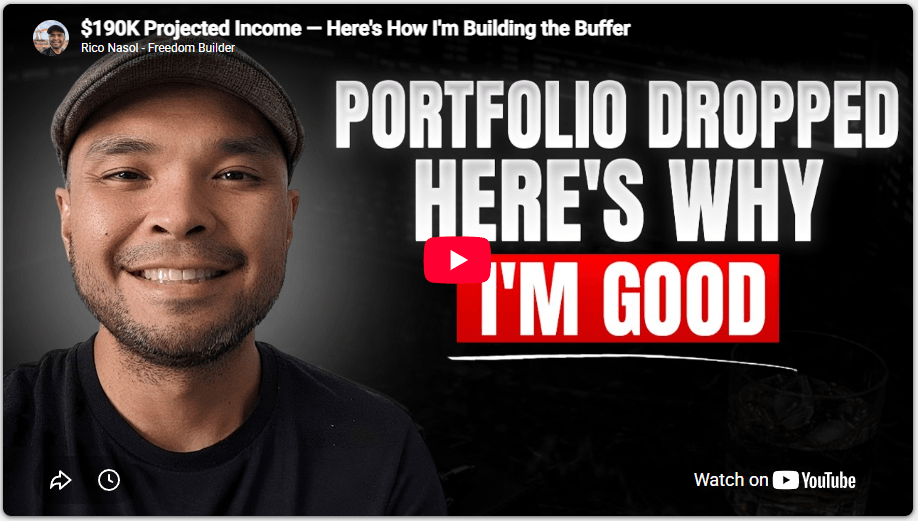
I missed you all.
After spending three weeks in the Philippines and Shanghai, it's great to be back. While you've been seeing pre-recorded content, I've been watching my portfolio closely—and June gave me plenty to think about.
The headlines aren't pretty.
My portfolio lost roughly $24,000 in market value during the month.
But here's the part that surprised many people:
My projected income barely changed.
That difference between capital and income is one of the most important concepts in income investing, and it's exactly what I want to break down today.
The Numbers
As of July 6, my portfolio sits at approximately $868,320, down from roughly $892,000 at the beginning of June.
That's about a $24,000 decline in portfolio value.
On the surface, that sounds painful.
But context matters.
June wasn't about bad stock picks or poor investment decisions.
The market simply cooled off.
Technology stocks pulled back after an incredible run, energy softened as tensions in the Middle East eased, and investors began reassessing lofty valuations after nearly two years of explosive growth.
If you're heavily invested in technology—as I am—you felt it.
Capital Went Down. Income Didn't.
While my portfolio value declined, my projected annual income remained just over $190,000, or roughly $16,000 per month.
That's not an accident.
It's exactly how I designed this portfolio.
One of my viewers recently asked me to compare capital value with projected income, and I thought it was a fantastic suggestion because this month's performance perfectly illustrates the difference.
A traditional growth portfolio depends almost entirely on rising asset prices.
An income portfolio is different.
Yes, the portfolio value fluctuates, but the assets continue producing cash flow.
Those are two completely different experiences during a market pullback.
My Income Goal Matters More Than My Portfolio Value
People often ask what number I watch most closely.
It isn't my account balance.
It's my projected annual income.
I've established a personal income floor of $150,000 per year.
Everything above that acts as a buffer.
Earlier this year, I briefly crossed the $200,000 annual income mark. Once I consistently reach that level again, I'll likely begin rotating more aggressively into conservative holdings.
At today's projected $190,000, I'm still comfortably above my target.
The market cooled off.
My income didn't.
That's exactly what I want from an income-focused portfolio.
Why the Portfolio Declined
The decline wasn't caused solely by market conditions.
Part of it was intentional.
During June, I reduced my largest position, CHPY, from 1,961 shares to 1,655 shares, pulling roughly $24,000 out of the position.
CHPY remains my largest holding and is still up more than 40% since I started buying it.
But success created a new problem.
It had simply become too large.
Rather than letting one position dominate my portfolio, I decided it was time to trim it and redeploy capital elsewhere.
I also reduced my position in FEPY, another technology-heavy income ETF.
This wasn't because I'd lost confidence in tech.
It was because I wanted to reduce concentration risk.
My Portfolio Rotation Has Already Started
This isn't a reaction to one difficult month.
It's a rotation I've been planning for a while.
June simply reinforced that it was time to begin executing it.
The strategy has three parts:
Reduce AI-heavy concentration.
Increase exposure to hardware and infrastructure.
Build stronger defensive positions outside of technology.
I'm still bullish on technology.
That hasn't changed.
But I also recognize that no sector leads forever.
Diversification matters.
Why I'm Adding More Defensive Holdings
As I reduce some technology exposure, I'm gradually adding positions designed to perform differently during changing market environments.
That includes areas like:
Energy
Consumer Staples
Gold
Utilities
These sectors don't require a technology bull market to generate income.
Instead, they provide diversification while continuing to support the portfolio's cash flow.
This isn't about predicting a recession.
It's about building a portfolio that can survive multiple market environments.
Small Positions, Big Lessons
I've also been experimenting with a few smaller positions.
One example is AMDW, Roundhill's weekly-paying AMD covered call ETF.
Like my earlier position in ARMW, this is a very small allocation.
Combined, these single-stock covered call ETFs represent less than 1% of my portfolio.
That sizing matters.
I'm willing to test ideas—but never with enough capital to jeopardize the portfolio if I'm wrong.
Building My Defensive Bucket
One of the biggest additions has been XLEI, State Street's Energy Premium Income ETF.
I nearly tripled my position during June.
Yes, it's currently down since I started buying it.
And yes, I knew that was possible.
My goal isn't to trade short-term energy prices.
It's to build an income source that isn't highly correlated with technology.
I've also started building positions in:
XLSI for consumer staples.
KGLD alongside IAUI for gold income.
Each serves a different purpose within my defensive allocation.
Knowing When to Exit
June also included several exits.
I completely closed my position in GDXY.
The investment had done its job.
I collected distributions, accepted the remaining loss, and moved on.
I also exited:
XBCI
XLYI
XLVI
Meanwhile, I continue holding BTCI, despite being down significantly.
Why?
Because my long-term conviction in Bitcoin remains intact, and the weekly income continues while I wait.
Sometimes the thesis changes.
Sometimes it doesn't.
Learning the difference is part of becoming a better investor.
Looking Ahead
As I move into the second half of the year, my priorities are becoming clearer.
I'm focusing on:
Less AI concentration.
More sector diversification.
Stronger defensive positions.
Continued exposure to gold.
Selective hardware investments.
Maintaining an annual income floor above $150,000.
Most importantly, I'm not rushing.
The income is still doing exactly what I built it to do.
That's what gives me the confidence to make thoughtful adjustments instead of emotional decisions.
Final Thoughts
June wasn't a great month if you only looked at portfolio value.
But that's only half the story.
Income investing isn't just about watching your account balance rise every month.
It's about building a portfolio that continues producing cash flow—even when markets become more challenging.
Capital will fluctuate.
Income can remain remarkably resilient.
That's the difference I'm trying to build into my own financial future.
Every dollar still has a job.
And my income snowball keeps rolling.
Book Flash Coaching Call Now.

Subscribe
Get early access to motivational emails, new content, and courses as soon as they arrive. I promise I won't send you anything else.


Contact Us
Feel free to get in touch with me at rico@riconasol.com
or book some time for us to chat by clicking here. Rico also coaches the greater Las Vegas and Henderson areas.
Open Hours
Mon - Fri: 9 AM – 6 PM
Saturday: Closed
Sunday: Closed
Location
Henderson, NV 89052
Email: rico@riconasol.com
Telephone: +1.702.900.7426

"Messy action is better than no action at all..." -Rico Nasol

Disclaimer: The Freedom Builder Bootcamp is for educational purposes only and does not constitute financial, investment, tax, or legal advice. Rico Nasol is not a registered investment advisor. All examples of specific funds or holdings are illustrations of the instructor's personal approach to his own money and are not recommendations. Investing involves risk, including possible loss of principal. Past performance does not guarantee future results. Consult a licensed professional before making investment decisions.
All Rights Reserved | Copyright Rico Nasol 2026 | Privacy Policy | Sitemap