


$222,749\/Year From an $875K Portfolio — Why the 4% Rule Is Dead
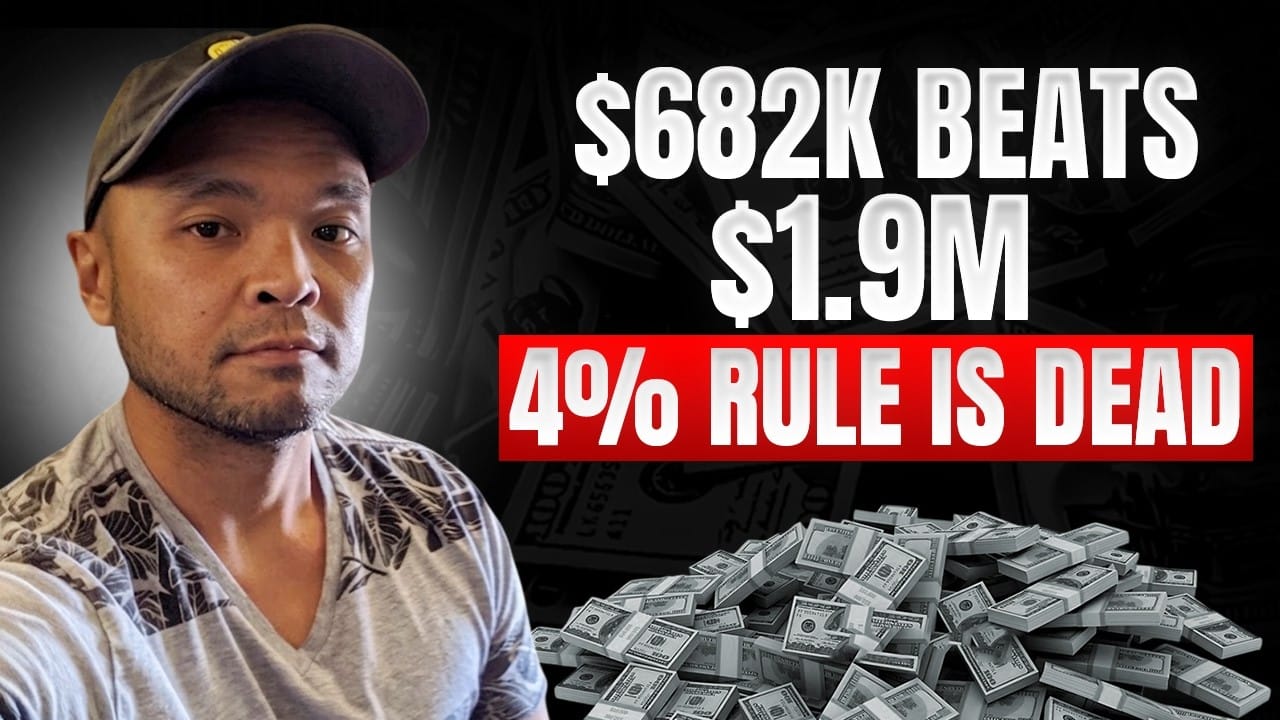
The 4% rule says you may need nearly $2 million to retire on $75,000 a year.
But what if there’s another path—one that requires less capital, avoids selling shares, and focuses on building income instead of slowly draining your portfolio?
Most retirement advice starts with one big question: How much money do you need before you can stop working? For decades, the default answer has been some version of the 4% rule. More recently, some investors have pushed the opposite extreme with an 8% withdrawal rule.
But after running the numbers, I’ve come to a very different conclusion.
Two people can retire with wildly different portfolio sizes, and the person with less money can still end up with more usable income, less stress, and more control—if they structure retirement around income investing instead of asset liquidation.
If I had understood this in my 20s or 30s, I would have approached wealth-building very differently.
Where the 4% Rule Came From
The 4% rule traces back to research from the 1990s. The idea was simple: if you retire with a balanced portfolio—typically 60% stocks and 40% bonds—you can withdraw 4% of your portfolio in year one, adjust that amount for inflation each year, and have a strong chance of not running out of money over a 30-year retirement.
At the time, that was a useful framework. But it was built for a different era:
higher bond yields
shorter retirement windows
a traditional 60/40 portfolio structure
market conditions that don’t look much like today’s environment
And yet, it’s still treated like universal retirement law.
What the 4% Rule Looks Like in Real Life
Let’s say you want $75,000 per year in retirement income.
Using the 4% rule, the math says you need:
$75,000 ÷ 0.04 = $1,875,000
So before you retire, you need nearly $1.9 million.
That alone is a huge hurdle, but the bigger issue is what happens next: you have to keep selling shares every year to fund your lifestyle.
If inflation rises, your withdrawals rise too. Over time, that means you’re liquidating more and more of your portfolio just to maintain the same standard of living. In a steady market, the plan may still work on paper. But emotionally, it can feel like watching your retirement account become a slowly shrinking ATM.
Yes, you may still end up with plenty of money at the end. But to me, that raises a fair question:
If you needed almost $2 million to retire and still had to sell assets every year, how efficient is that system really?
Why the 8% Rule Sounds Better Than It Is
Then there’s the more aggressive version: the 8% rule.
Same $75,000 annual need, but now the required portfolio drops to:
$75,000 ÷ 0.08 = $937,500
That sounds amazing. Less than a million dollars, same lifestyle, and theoretically you’re still leaving room for growth if markets average 10%+ annually.
The problem is that retirement doesn’t happen on a spreadsheet. It happens in the real world, where the first few years matter a lot.
If you retire into a bear market and you’re withdrawing 8% while your portfolio is down 15–20%, the math can unravel fast. That’s sequence-of-returns risk: taking withdrawals while your portfolio is falling early in retirement can permanently damage your long-term outcome.
On paper, the 8% rule can look efficient. In a bad market, it can become dangerous.
The Alternative: Build Retirement Around Income
Now let’s flip the question.
Instead of asking, “How much can I withdraw without running out of money?” what if you asked:
“How much capital do I need to build a portfolio that pays me the income I need?”
That’s the framework I use.
If your retirement portfolio generates 11% in annual income, and you need $75,000 per year, the math looks like this:
$75,000 ÷ 0.11 = $681,818
That’s less than $700,000.
Not $1.9 million.
Not even $1 million.
And the biggest difference is this: you’re not funding retirement by selling shares. You’re funding it through distributions and dividends from assets specifically chosen to generate income.
That changes everything.
Comparing the Three Approaches
Here’s how the three models stack up if your goal is to generate $75,000 per year:
1) The 4% Rule
Capital required: about $1.875 million
How income is generated: sell shares every year
Main risk: you must keep liquidating assets, even during down markets
Best-case outcome: portfolio may still grow, but you started with a very large number and spent retirement gradually drawing it down
2) The 8% Rule
Capital required: about $937,500
How income is generated: also by selling shares
Main risk: very vulnerable to a bad sequence of returns early in retirement
Best-case outcome: works if markets cooperate; breaks quickly if they don’t
3) Income Investing at 11%
Capital required: about $682,000
How income is generated: distributions from the portfolio
Main risk: distribution cuts, NAV erosion, poor fund selection, concentration risk
Main advantage: no need to sell shares to fund your lifestyle
That last point matters to me more than almost anything else.
Because if the portfolio is built correctly, retirement stops feeling like a countdown clock and starts feeling like a system.
The Catch: Income Investing Isn’t Magic
None of this means income investing is risk-free. It’s not.
High-yield strategies come with their own issues:
NAV erosion
distribution cuts
sector concentration
fund structure risk
yield traps disguised as opportunity
I’ve made those mistakes. I’ve been burned by chasing income without enough structure. So I’m not pitching this as some flawless shortcut. I’m saying it can be a better framework if you actually build it intentionally.
That’s why I don’t think about my portfolio as one giant pile of assets. I think about it in buckets.
My Retirement Framework: The Three-Bucket System
The way I structure income investing is through three buckets:
1) Income Engine
This is the aggressive bucket. These are the higher-yield positions that generate meaningful cash flow now. They’re useful in the building phase, but they also come with higher risk and more volatility.
2) Core Holdings
These are the more stable income funds I want to lean on long term—positions that still generate strong income, but with better structure, better diversification, and less drama.
3) Defensive Bucket
This is where I want capital positioned when markets get ugly. The goal here is stability, resilience, and reducing the damage from major drawdowns.
That structure matters because the right retirement portfolio is different depending on what phase you’re in.
Why My Current Yield Is Higher Than My Retirement Yield
Right now, my portfolio is producing a much higher yield than what I’d want to rely on forever. That’s intentional.
I’m still in what I call the building phase. I already retired from corporate, but I still have some active income coming in from coaching, content, and projects I choose to take on. That gives me room to be more aggressive in the income engine bucket while continuing to grow the portfolio.
But when I’m fully done with active income, the plan changes.
At that point, the goal won’t be maximum yield. It’ll be sustainable yield.
That’s when I expect to rotate more heavily into the core and defensive buckets—funds with lower risk, more stability, and yields in a range that can still comfortably fund retirement without forcing me to sell shares.
That’s why I used 11% in the earlier example. Not because I think everyone should chase double-digit yield forever, but because I believe a properly structured income portfolio can still generate enough income to outperform the traditional retirement math without requiring $2 million upfront.
The Real Question Retirement Advice Should Ask
The 4% rule asks:
How much can I withdraw before I run out of money?
Income investing asks:
How do I build a portfolio that pays me enough so I don’t need to keep selling it?
Those are very different questions.
One treats retirement like a controlled drawdown.
The other treats retirement like a cash-flow system.
That’s the shift that changed how I think about financial freedom.
Final Thoughts
I’m not saying the 4% rule is useless. It’s still a useful benchmark. And I’m definitely not saying income investing is the only path. But I do think too many people accept the idea that retirement automatically requires $2 million plus decades of carefully selling assets.
It doesn’t have to.
If your goal is to live off portfolio income, reduce reliance on market timing, and create a system that keeps paying you without liquidating your nest egg, income investing deserves a serious look.
The key is not chasing yield blindly. The key is building a structure that matches your phase of life, your risk tolerance, and the job each dollar needs to do.
Because in the end, retirement isn’t just about how much money you have.
It’s about how that money works for you once you stop working for it.
Book A FREE Discovery Call Now.

Subscribe
Get early access to motivational emails, new content, and courses as soon as they arrive. I promise I won't send you anything else.


Contact Us
Feel free to get in touch with me at rico@riconasol.com
or book some time for us to chat by clicking here. Rico also coaches the greater Las Vegas and Henderson areas.
Open Hours
Mon - Fri: 9 AM – 6 PM
Saturday: Closed
Sunday: Closed
Location
Henderson, NV 89052
Email: rico@riconasol.com
Telephone: +1.702.900.7426

"Messy action is better than no action at all..." -Rico Nasol

All Rights Reserved | Copyright Rico Nasol 2026 | Privacy Policy | Sitemap