


Tired of Zero Dividends? Here's How I Made $18,522 in April
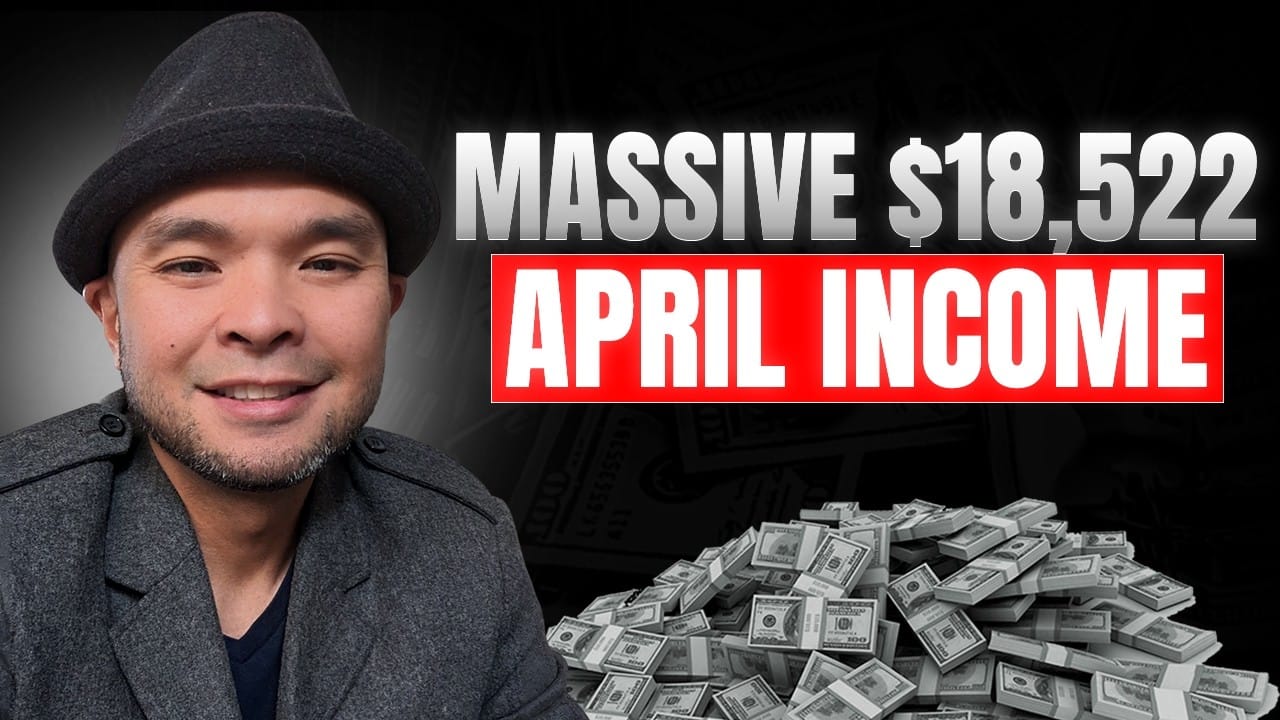
My portfolio paid me $18,522 in April.
That's up nearly 30% from the month before.
More importantly, it's real cash hitting my brokerage account from investments that are largely doing their job without requiring constant attention.
But this isn't just another income report.
Because while the distributions were impressive, the bigger story was what happened afterward.
In the weeks that followed, I rotated out of underperforming positions, added to winners, and launched three new portfolio experiments that could potentially shape where future capital goes.
Today, I'm pulling back the curtain on exactly where that $18,522 came from, what changes I made, and what I'm watching next.
If you'd rather watch the full portfolio breakdown, you can view the complete video here:
The Numbers Behind April's Income
Every month, I publish one of these portfolio updates because I believe investors learn more from real numbers than hypothetical projections.
April's total income came in at:
$18,522 in distributions
Breaking that down further:
$617 per day
$4,631 per week
And compared to March's income of $15,641, that's a roughly 30% increase month-over-month.
At first glance, those numbers look incredible.
But there's an important lesson here.
Income investors often focus too much on a single month.
The reality is that different funds pay on different schedules. Some months will naturally be higher than others.
That's why I focus on rolling trends instead.
Across March and April combined, the portfolio generated:
$34,164 in income
That's the number that matters more to me.
The Hidden Story: Portfolio Growth
The distributions were only part of the story.
On April 30th, my portfolio value stood at:
$838,312
Just twelve days later, on May 12th:
$880,000
That's more than $42,000 in unrealized gains in less than two weeks.
Those gains weren't just nice to look at.
They became signals.
Signals that it was time to rebalance, redeploy capital, and make strategic adjustments.
Chippy Continues to Dominate
If you've followed the channel for any length of time, this won't surprise you.
My largest income producer in April was once again:
CHPY (YieldMax Semiconductor Covered Call ETF)
April Income:
$5,089
For comparison:
March Income: $1,654
That's a staggering 207% increase month-over-month.
Why?
Because CHPY benefits from exactly the type of market environment we experienced in April.
Strong semiconductor performance
Elevated volatility
Rich option premiums
Weekly distribution schedule
The combination created a perfect setup for higher payouts.
And the price action didn't hurt either.
Between late April and mid-May:
Price moved from roughly $62.79
To approximately $74.57
An increase of about 18% in just three weeks.
Why I'm Trimming a Winner
This may sound counterintuitive.
CHPY is working.
The income is strong.
The price appreciation has been exceptional.
So why would I sell any?
Because concentration risk matters.
CHPY now represents approximately 18.6% of my portfolio.
That's not because I intentionally allocated that much capital.
It's because the position grew.
And part of portfolio management is allowing winners to fund future opportunities.
My plan is simple:
Take some gains
Lock in profits
Reallocate capital into new experiments
Not because CHPY is broken.
Because it's doing its job.
The GDXY Rotation
One of the biggest changes I made involved GDXY.
If you've watched previous updates, you know this position had become increasingly difficult to justify.
The thesis wasn't necessarily broken.
I'm still bullish on gold and miners over the long term.
But portfolio management isn't just about being right.
It's about opportunity cost.
I reduced my position from:
5,700+ shares
To roughly:
875 shares
That meant realizing losses.
But it also freed up capital that could potentially work harder elsewhere.
This wasn't an emotional decision.
It was a thesis-based exit.
And that's an important distinction.
The Three New Portfolio Experiments
The capital from GDXY didn't sit in cash.
It immediately went to work.
I've currently launched three separate portfolio experiments.
Each designed to answer a different question.
Experiment #1: NEOS Boosted ETFs
The first experiment focuses on NEOS Investments' newly launched boosted ETF lineup.
Current positions include:
XQQI
Approx. $8,000 invested
XSPI
Approx. $6,700 invested
XBCI
Approx. $1,200 invested
Total allocation:
~$16,000
The objective is straightforward.
Can these funds generate meaningfully higher income while avoiding excessive NAV erosion?
If the answer is yes, these positions could earn larger allocations over time.
If not, the experiment ends and the capital moves elsewhere.
Experiment #2: State Street Sector Income ETFs
The second experiment focuses on diversification.
Historically, my portfolio has been heavily concentrated in technology.
These positions allow me to generate income from sectors outside of tech.
Current sectors include:
Utilities
Industrials
Materials
Energy
Healthcare
Combined allocation:
~$32,000
I'm intentionally keeping these positions small.
I want at least a quarter's worth of data before making larger commitments.
Why Energy and Healthcare?
Energy was an easy decision.
Between geopolitical uncertainty and strong commodity markets, the sector continues benefiting from powerful tailwinds.
Healthcare is different.
It's a contrarian bet.
Healthcare has significantly underperformed technology over the past few years.
If leadership rotates away from semiconductors and AI, healthcare could quietly become one of the strongest opportunities available.
For now, it's a test.
But it's a test I'm watching closely.
Experiment #3: SEPY
The third experiment may be the most controversial. SEPY
SEPY combines:
Crypto-related equities
Covered call income generation
Its holdings include companies such as:
Coinbase
Bitcoin miners
Strategy (formerly MicroStrategy)
Other crypto-linked businesses
I deployed roughly:
$19,000
into the position.
The goal isn't to maximize crypto exposure.
The goal is to determine whether crypto-linked income can become a sustainable part of the portfolio.
The position has already paid its first distribution.
Now it's time to see how the thesis develops.
What the Portfolio Looks Like Today
Following the rebalancing activity, the portfolio is now organized into four primary buckets.
Income Engine
The workhorses.
Positions designed to generate substantial monthly cash flow.
Examples include:
CHPY
FEPI
BTCI
SEPY
Core Foundation
The long-term income layer.
Including positions such as:
QQQI
SPYI
IWMI
Defensive Mode
The diversification bucket.
Including:
State Street sector ETFs
Utilities
Industrials
Healthcare
Materials
Energy
Experimental Bucket
The newest ideas.
Combined allocation:
Approximately $56,000
Large enough to matter.
Small enough to fail safely.
One More Position I'm Watching
There's one position currently on notice:
ESPY
The thesis simply isn't performing the way I expected.
The fund performs best in flat markets.
And we've been experiencing anything but a flat market.
At the moment, there's a strong possibility I exit the position entirely and redeploy that capital into stronger opportunities.
Stay tuned.
What I'm Watching Over the Next Few Weeks
Several questions remain unanswered.
1. How Much of CHPY Should I Trim?
The fund continues to perform exceptionally well.
But concentration risk remains real.
The goal is to gradually lock in gains without disrupting the income stream.
2. Do the NEOS Boosted ETFs Justify the Risk?
In another month or so, I'll have enough data to evaluate:
Yield sustainability
NAV performance
Total return
That's when the real decision gets made.
3. Can SEPY Deliver on the Crypto Income Thesis?
Crypto remains one of my highest-conviction long-term themes.
But conviction isn't enough.
The numbers have to support the thesis.
4. Which State Street Sectors Earn More Capital?
This is still a live experiment.
The winners will eventually receive additional allocations.
The losers won't.
Final Thoughts
Most people look at the headline:
"$18,522 in one month."
But that's not the real lesson.
The real lesson is what happens after the income arrives.
It's:
Trimming winners
Exiting weaker positions
Redeploying capital
Testing new ideas
Staying disciplined
Income alone doesn't build wealth.
Capital allocation does.
That's the framework I continue using today.
Income first.
Growth layered intentionally.
Defense built in from the beginning—not added later.
And so far, that approach continues to move the portfolio in the right direction.
Book A FREE Discovery Call Now.

Subscribe
Get early access to motivational emails, new content, and courses as soon as they arrive. I promise I won't send you anything else.


Contact Us
Feel free to get in touch with me at rico@riconasol.com
or book some time for us to chat by clicking here. Rico also coaches the greater Las Vegas and Henderson areas.
Open Hours
Mon - Fri: 9 AM – 6 PM
Saturday: Closed
Sunday: Closed
Location
Henderson, NV 89052
Email: rico@riconasol.com
Telephone: +1.702.900.7426

"Messy action is better than no action at all..." -Rico Nasol

All Rights Reserved | Copyright Rico Nasol 2026 | Privacy Policy | Sitemap