


The New Weekly Income ETFs You Haven't Heard of Yet
A New Player Enters the Weekly Income Race
It feels like a new income ETF launches every month.
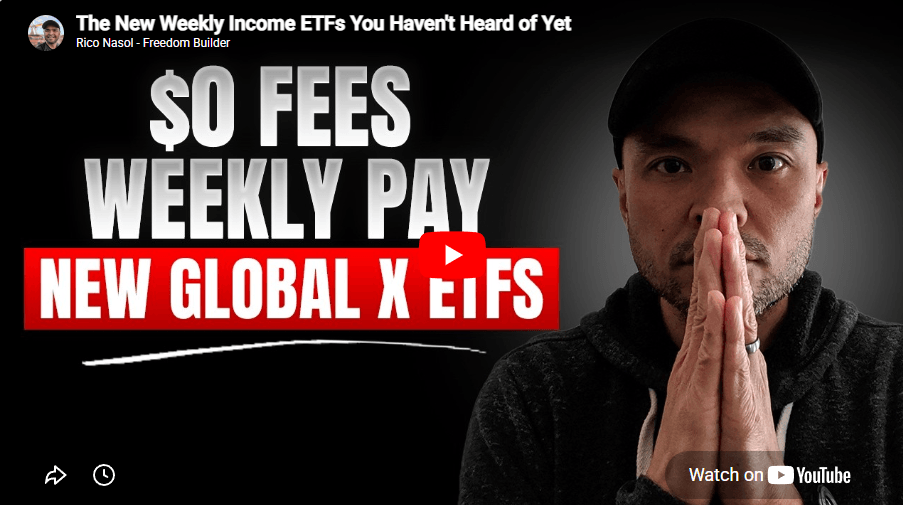
This time it's Global X introducing two new weekly-paying funds: EDGQ (NASDAQ 100 Income Edge ETF) and EDGX (US 500 Income ETF). Both launched in February 2026 and are designed to provide consistent weekly income while maintaining more upside participation than traditional covered-call funds.
What caught my attention wasn't just the weekly payouts. It was the strategy behind them.
Unlike many covered-call ETFs that sell options on a fixed percentage of their portfolios, these funds use a variable coverage approach that adjusts based on market conditions.
That could be a meaningful difference.
If you'd rather watch the full breakdown, you can view the complete video here:
What Are EDGQ and EDGX?
At a high level, the funds are straightforward:
EDGQ
Tracks the NASDAQ 100
Targets a 13% annual distribution rate
Pays weekly
Up roughly 11% since launch
EDGX
Tracks the S&P 500
Targets a 9% annual distribution rate
Pays weekly
Up roughly 6% since launch
Both funds have been remarkably close to achieving their stated income targets so far.
That's notable because many income funds either over-distribute or struggle to consistently meet their yield objectives.
The Strategy That Makes Them Different
Most traditional covered-call ETFs follow a simple formula: sell options against a fixed percentage of the portfolio regardless of market conditions.
EDGQ and EDGX take a more flexible approach.
Each week, portfolio managers evaluate:
Market volatility
Option premiums
Interest rates
Market conditions
They then determine how much of the portfolio should be covered in order to generate that week's target income.
Global X expects option coverage to average around 25% over time, although that number can move significantly higher or lower depending on market conditions.
The potential advantage is obvious:
If only 25% of the portfolio is covered, roughly 75% remains fully exposed to market upside.
That's a very different profile than funds that write calls on nearly all of their holdings.
The Zero-Fee Advantage
One of the biggest surprises is the fee structure.
Both funds normally carry a 0.50% expense ratio.
However, Global X has waived management fees until at least March 2027.
For now, investors pay:
0.00%
That's unusual in the income ETF space.
For comparison:
QDTE: 0.95%
XDTE: 0.95%
SPYI: 0.68%
QQQI: 0.68%
A fee waiver alone isn't enough reason to invest, but it certainly lowers the barrier for investors interested in testing the strategy.
Early Performance Looks Impressive
It's important to remember that we're only looking at about three months of data.
That's nowhere near enough to draw long-term conclusions.
Still, the early numbers deserve attention.
Total Return (Including Distributions)
Over the first three months:
QQQ: +19.5%
EDGQ: +16.6%
QDTE: +14.3%
SPY: +9.4%
EDGX: +8.8%
XDTE: +6.4%
SPYI: +6.1%
YSPY: +1.0%
EDGQ has been the second-best performer in the group, trailing only QQQ itself.
That's impressive for a fund paying weekly distributions.
Price Return Only
Looking strictly at share price appreciation:
QQQ: +19.3%
EDGQ: +13.1%
SPY: +9.1%
QDTE: +6.6%
EDGX: +6.6%
SPYI: +3.0%
XDTE: +1.0%
TQQY: -4.5%
YSPY: -10.0%
The biggest takeaway is that EDGQ has preserved significantly more upside than many competing weekly-income funds.
The Biggest Concern
The biggest issue isn't performance.
It's size.
Currently:
EDGQ has roughly $4.2 million in assets
EDGX has roughly $2.4 million in assets
Those numbers are tiny compared to competitors.
Smaller funds often come with wider bid-ask spreads, making them more expensive to trade.
Both funds currently show spreads around 0.45%.
For a long-term investor, that's manageable.
For active traders, it can become a meaningful drag on returns.
This is something I'll be monitoring closely over the next several months.
How Do They Compare to SPYI and QQQI?
This is where things get interesting.
The yields are fairly similar:
EDGQ targets 13%
QQQI currently yields around 13-14%
EDGX targets 9%
SPYI generally yields around 9-12%
However, the strategies are very different.
SPYI and QQQI use Section 1256 contracts, which provide attractive tax treatment and have already proven themselves through various market environments.
EDGQ and EDGX rely on variable option coverage, which may allow for greater upside participation but hasn't yet been tested over a full market cycle.
The concept is promising.
The track record is still developing.
My Take
I'm interested, but I'm not buying yet.
The performance has been better than I expected. The variable coverage model appears to be working, and the zero-fee period makes these funds even more appealing.
But three months isn't enough data for me.
I want to see how they perform during a pullback. I want to see whether distributions remain consistent. And I want a better understanding of the long-term tax implications before comparing them directly to funds like SPYI, QQQI, or even the newer ROCY and ROCQ offerings.
For now, they're firmly on my watchlist.
Final Thoughts
The weekly-income ETF space is becoming increasingly competitive.
That's good news for investors.
EDGQ and EDGX bring something genuinely different to the table with their variable coverage approach, and the early results suggest the strategy may be helping preserve more upside than traditional covered-call funds.
Whether that advantage holds up over time remains to be seen.
For now, I think they're worth watching closely—but not necessarily worth rushing into.
Sometimes the best investment decision is simply gathering more data.
Book A FREE Discovery Call Now.

Subscribe
Get early access to motivational emails, new content, and courses as soon as they arrive. I promise I won't send you anything else.


Contact Us
Feel free to get in touch with me at rico@riconasol.com
or book some time for us to chat by clicking here. Rico also coaches the greater Las Vegas and Henderson areas.
Open Hours
Mon - Fri: 9 AM – 6 PM
Saturday: Closed
Sunday: Closed
Location
Henderson, NV 89052
Email: rico@riconasol.com
Telephone: +1.702.900.7426

"Messy action is better than no action at all..." -Rico Nasol

All Rights Reserved | Copyright Rico Nasol 2026 | Privacy Policy | Sitemap