


Goldman Sachs Just Bought NEOS for $2.3 Billion. What Happens to These Income ETFs?
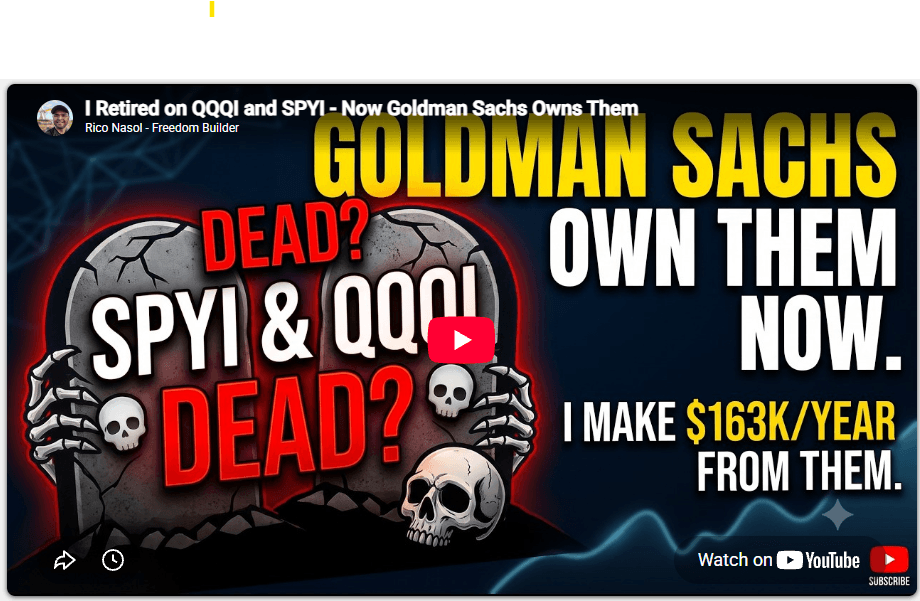
One of the most trusted names in income ETFs just got acquired—and the buyer is Goldman Sachs. On August 12, 2026, Goldman announced an agreement to acquire NEOS Investments for up to $2.25 billion in cash and equity.
For investors like me who rely heavily on NEOS funds for income, this is significant. I currently hold several NEOS ETFs, and together they generate roughly $44,000–$50,000 a year in income for my portfolio.
The acquisition could give NEOS more resources and scale, but it could also change some of the things that made these funds attractive in the first place. Until the deal closes in Q1 2027, there are four things I'm watching closely.
Why Goldman Sachs Wants NEOS
NEOS currently manages about $30 billion across 19 ETFs, including SPYI, QQQI, and several other income-focused funds.
The acquisition makes sense because option-income ETFs have exploded in popularity. The category has grown from virtually nothing in 2021 to more than $180 billion in assets, representing roughly a 70% compound annual growth rate over the past five years.
Two funds are especially important: QQQI, with about $14 billion in assets, and SPYI, with about $11 billion. Together, they account for roughly 84% of NEOS's assets.
Goldman is clearly positioning itself to capture more of this rapidly growing ETF market. Once the acquisition closes, Goldman Sachs Asset Management is expected to manage more than $130 billion in ETF assets, making it one of the largest active ETF managers in the world.
Goldman has also been building its options ETF business through its acquisition of Innovator Capital Management, which specializes in buffer ETFs.
That creates a pretty clear strategy: Innovator provides the buffer ETF business, while NEOS brings the income ETF business.
For NEOS investors, that's potentially encouraging, but the real question is what Goldman does with these businesses after the acquisitions.
Will Goldman Change the NEOS Formula?
This is where investors need to pay attention.
The first thing I'm watching is expense ratios. SPYI and QQQI currently charge about 0.68%, which is reasonable for actively managed option strategies using Section 1256 contracts.
But Goldman has comparable income ETFs charging considerably less. Its GPIX and GPIC funds charge around 0.29%, while JPMorgan's comparable funds are around 0.35%.
That creates an interesting possibility: Goldman could use its scale and infrastructure to reduce NEOS fees.
If expenses move toward the 0.35%–0.50% range, that could be a genuine win for long-term investors because more of the fund's return would remain in shareholders' pockets.
I'm also watching the investment team.
NEOS founders Troy Kates and Garrett Paolella are expected to remain with Goldman Sachs Asset Management, and the broader NEOS team is expected to transition as well. The acquisition price is also tied partly to performance and service commitments, which creates some alignment between the founders and the future success of the funds.
But the founders aren't the only people who matter.
The portfolio managers and options-execution team are critical to maintaining the strategies that generate these distributions. If experienced people begin quietly leaving after the acquisition, that would be a yellow flag for me.
The Most Important Thing: Income and Tax Treatment
The issue I'm watching most closely is monthly distributions because that's where any meaningful change would hit my portfolio directly.
SPYI has historically delivered remarkably consistent monthly distributions. That consistency is not accidental. It's tied to the investment process NEOS developed, including its use of Section 1256 contracts.
If Goldman eventually changes how these options strategies are implemented, the amount of income might not necessarily change, but the after-tax income could.
That's a major consideration for income investors.
I'm also watching the funds' 19a-1 notices, which provide information about how distributions are classified. If the percentage classified as return of capital begins changing significantly, that could indicate something has shifted beneath the surface.
The final thing I'm watching is branding and independence.
NEOS has said the existing tickers will remain unchanged and that the business will continue operating as a focused ETF operation within Goldman Sachs Asset Management.
That's important.
If the NEOS brand remains intact and the team maintains meaningful autonomy, I would view that positively. If the funds gradually become fully integrated into the Goldman brand and investment structure, it could signal that the original NEOS approach is changing.
The brand itself isn't the investment thesis, but it can be a useful signal of how much independence the acquired company actually retains.
What Investors Should Do Before 2027
For now, I'm not making any knee-jerk moves.
The acquisition is not expected to close until Q1 2027, pending regulatory approval and a shareholder vote. Until then, the funds continue operating as they have been.
When the proxy materials arrive, investors should actually read them. The documents will include details about the proposed new investment advisory agreement and board of trustee nominees.
Those documents may tell us more about Goldman's intentions than any press release.
Between now and the closing, I'm keeping four things on my watchlist:
Expense ratios — Could Goldman reduce costs?
Investment team — Are the people responsible for the strategies staying?
Distributions — Are income levels and tax classifications remaining consistent?
Brand and autonomy — Is NEOS remaining an independent operation within Goldman?
I'm also watching what happens with Innovator. Its acquisition closed only a few months ago, so it's too early to know whether the deal will ultimately be a success. But over the next year or two, it could become a useful real-world example of how Goldman handles acquired ETF businesses.
Final Thoughts
I'm not running from my NEOS positions.
With roughly $44,000–$50,000 in annual income tied to the funds I hold, this acquisition matters to me personally. But I also don't think a major acquisition is a reason to panic.
It could ultimately be a huge positive.
Goldman brings scale, resources, distribution, and institutional infrastructure that could help NEOS grow even further. Lower expenses and additional resources could make these already-popular income ETFs even more attractive.
But there's another possibility: Goldman could gradually change the investment process, team, tax structure, fees, or identity that made NEOS successful in the first place.
That's why I'm choosing informed patience over panic or blind faith.
For now, my NEOS funds are still doing their job. I'll continue watching the team, distributions, expenses, proxy documents, and Goldman's handling of Innovator.
The acquisition isn't the end of the NEOS story. It's the beginning of a new chapter.
And for income investors, the lesson is simple: don't react to the headline. Watch what actually changes underneath it.
Book Flash Coaching Call Now.

Subscribe
Get early access to motivational emails, new content, and courses as soon as they arrive. I promise I won't send you anything else.


Contact Us
Feel free to get in touch with me at rico@riconasol.com
or book some time for us to chat by clicking here. Rico also coaches the greater Las Vegas and Henderson areas.
Open Hours
Mon - Fri: 9 AM – 6 PM
Saturday: Closed
Sunday: Closed
Location
Henderson, NV 89052
Email: rico@riconasol.com
Telephone: +1.702.900.7426

"Messy action is better than no action at all..." -Rico Nasol

Disclaimer: The Freedom Builder Bootcamp is for educational purposes only and does not constitute financial, investment, tax, or legal advice. Rico Nasol is not a registered investment advisor. All examples of specific funds or holdings are illustrations of the instructor's personal approach to his own money and are not recommendations. Investing involves risk, including possible loss of principal. Past performance does not guarantee future results. Consult a licensed professional before making investment decisions.
All Rights Reserved | Copyright Rico Nasol 2026 | Privacy Policy | Sitemap