


JP Morgan's SECRET New Income ETFs Are DESTROYING Their Own Funds
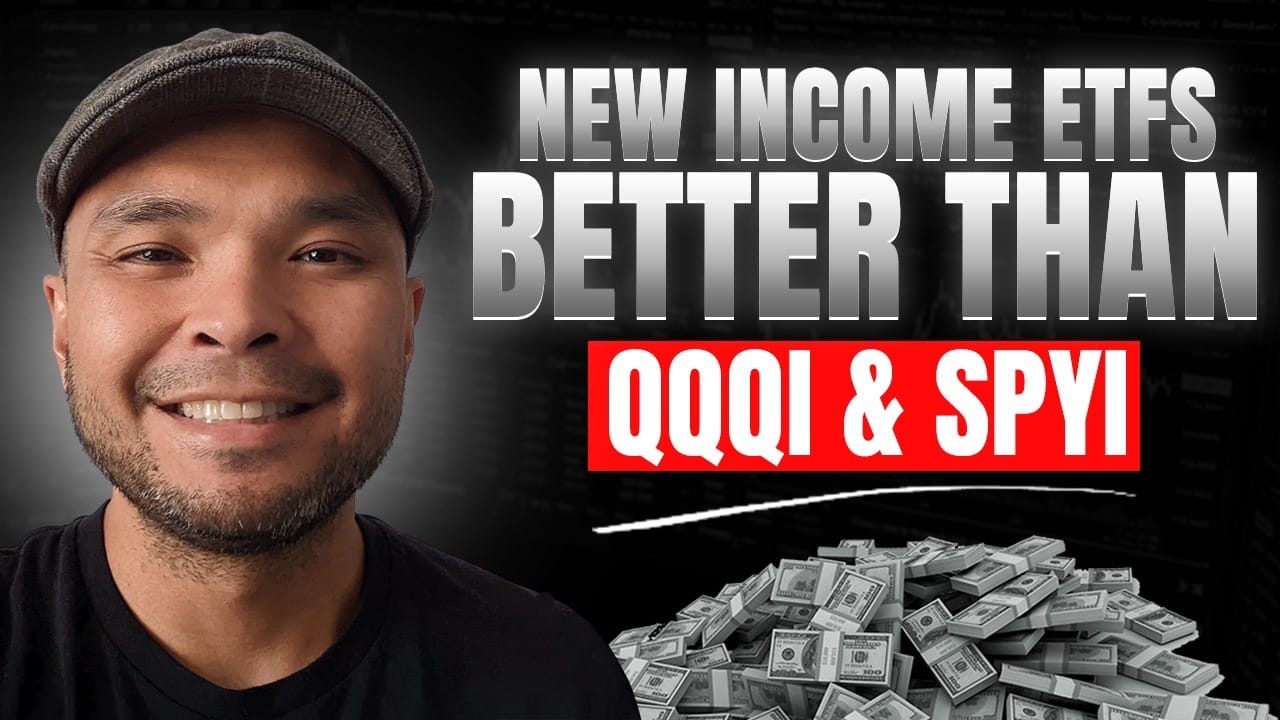
Two income ETFs launched less than two months ago.
Ordinarily, that wouldn’t be enough to get my attention. New funds launch all the time. Most spend years proving themselves before earning a place on an investor’s watchlist.
But these aren’t just any new funds.
They’re from JPMorgan—the same team behind JEPI and JEPQ, two of the most successful income ETFs ever created.
And despite their short track record, ROCY and ROCQ are already posting performance numbers that outperform their older siblings.
That raised a simple question:
What exactly is JPMorgan doing differently this time?
If you’d rather watch the full breakdown with charts and portfolio analysis, you can watch the complete video here:
Why These Funds Deserve Attention
Income investors are always searching for the same balance:
Attractive yield
Reasonable upside participation
Tax efficiency
Risk management
The challenge is that most covered-call strategies force you to sacrifice one or more of those benefits.
You either give up too much upside, pay higher fees, or accept a strategy that's difficult to fully understand.
ROCY and ROCQ attempt to solve that problem.
While they share the same DNA as JEPI and JEPQ, they take a noticeably different approach under the hood.
Meet ROCY and ROCQ
Both funds launched on March 19, 2026.
ROCY
ROCY focuses on large-cap U.S. equities and broadly resembles an S&P 500 portfolio.
Current allocations include:
Technology (~32%)
Financials
Healthcare
Industrials
Consumer Discretionary
The fund currently holds roughly 111 stocks and is designed to generate income while maintaining broad market exposure.
ROCQ
ROCQ follows a Nasdaq-oriented strategy.
Its portfolio includes many familiar names:
Nvidia
Apple
Microsoft
Amazon
Alphabet
Broadcom
Technology represents nearly half of the portfolio, making ROCQ a more growth-oriented income solution.
In many ways, ROCQ is attempting to do for Nasdaq investors what ROCY is doing for S&P investors.
What Makes Them Different From JEPI and JEPQ?
This is where things get interesting.
JEPI and JEPQ primarily generate income using Equity Linked Notes (ELNs).
The strategy has worked exceptionally well, but it comes with one drawback:
Investors can't easily see what's happening inside the options structure.
The mechanics largely remain behind the curtain.
ROCY and ROCQ take a different path.
Instead of relying on ELNs, they use direct call spread strategies.
That change creates two major advantages.
Greater Transparency
Because the options positions are held directly inside the funds, investors can see:
Strike prices
Expiration dates
Current positions
For investors who like understanding exactly how income is being generated, that's a meaningful improvement.
More Upside Participation
Traditional covered-call strategies often cap gains once the sold call reaches its strike price.
Call spreads work differently.
By combining a sold call with a purchased call at a higher strike, the strategy can retain more participation during strong market rallies.
That distinction appears to be showing up in the performance data.
The Tax Efficiency Story
One of the most attractive features of these funds is their distribution structure.
ROCY and ROCQ are designed to distribute income primarily as Return of Capital (ROC).
For income-focused investors, that can create meaningful tax advantages.
Generally speaking:
Taxes are deferred
Cost basis is adjusted downward
Investors may keep more cash flow in the short term
This differs from the approach used by funds such as SPYI and QQQI, which utilize Section 1256 contracts to achieve tax efficiency.
Different structure.
Same objective.
More after-tax income.
Lower Fees Than Many Competitors
Another surprise was the expense ratio.
ROCY and ROCQ
0.35%
SPYI and QQQI
0.68%
That's nearly half the cost.
While fees alone shouldn't drive investment decisions, lower expenses create a higher hurdle for competing funds to justify their premiums.
When performance and yield remain competitive, lower costs become increasingly attractive.
Early Performance Results
Let's be clear:
This is an extremely short evaluation period.
We're looking at less than two months of data.
Still, the early numbers are difficult to ignore.
Nasdaq-Focused Comparison
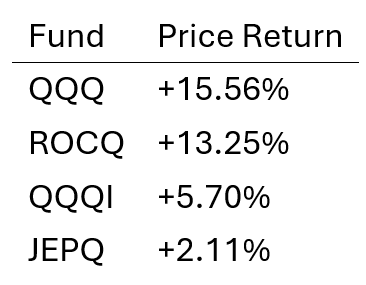
ROCQ has captured most of the Nasdaq's upside while still functioning as an income vehicle.
That's impressive.
S&P-Focused Comparison
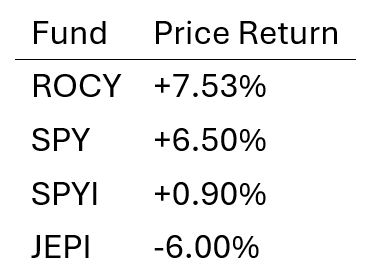
ROCY has actually outperformed the S&P 500 itself during this short period.
Again, early.
But noteworthy.
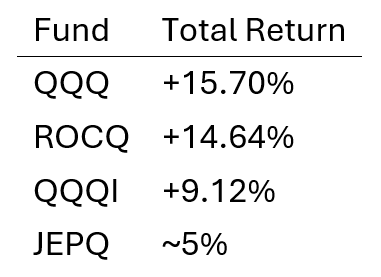
Total Return Tells an Even Better Story
Once distributions are included, the results become even more compelling.
Nasdaq-Based Funds
S&P-Based Funds
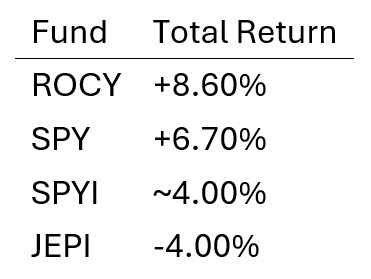
For an income-focused strategy to remain this close to its benchmark while distributing double-digit yields is exactly what investors hope to see.
Current Yield Snapshot
As of this review:
ROCQ
Yield: ~14.21%
Annual distribution: ~$8 per share
ROCY
Yield: ~12.43%
Annual distribution: ~$6.66 per share
For comparison:
QQQI: ~13.6%
SPYI: ~12.3%
The yields remain competitive despite the stronger upside participation.
That's a combination worth paying attention to.
The Biggest Risk Investors Should Remember
The temptation is to look at these numbers and assume a new champion has arrived.
I think that's premature.
These funds have not yet experienced:
A prolonged bear market
A major market correction
An extended sideways market
Multiple years of distribution history
We simply don't know how they'll behave across different market cycles.
Patience still matters.
My Current Position
At the moment, I'm watching rather than buying.
Not because I dislike what I see. Quite the opposite.
What I'm seeing is promising enough that I want more data before committing capital.
The combination of:
Low fees
Tax-efficient distributions
Transparent options strategies
Strong early performance
makes ROCY and ROCQ two of the most interesting ETF launches I've seen this year.
If they continue delivering these results over the next six to twelve months, they could become serious contenders for a place in my income portfolio.
For now, they remain firmly on the watchlist.
Final Thoughts
The income ETF landscape continues to evolve.
For years, investors had to choose between maximizing yield and maintaining upside participation.
ROCY and ROCQ suggest that tradeoff may not be as severe as it once was.
The early results are encouraging.
But investing isn't about finding the hottest new fund.
It's about finding strategies that can survive across multiple market environments.
These ETFs have made a strong first impression.
Now they need to prove they can sustain it.
**
Have you looked into ROCY or ROCQ yet?
Do you think they have the potential to challenge JEPI, JEPQ, SPYI, or QQQI over the long term?
I'd love to hear your thoughts in the comments.
If you'd like to see my full portfolio and discuss strategies with other income-focused investors, check out the Substack community. I also have a free Freedom Calculator that can help determine your financial independence timeline.
If it doesn't challenge you, it doesn't change you.
Messy action is better than no action.
I'll see you next time.
Book A FREE Discovery Call Now.

Subscribe
Get early access to motivational emails, new content, and courses as soon as they arrive. I promise I won't send you anything else.


Contact Us
Feel free to get in touch with me at rico@riconasol.com
or book some time for us to chat by clicking here. Rico also coaches the greater Las Vegas and Henderson areas.
Open Hours
Mon - Fri: 9 AM – 6 PM
Saturday: Closed
Sunday: Closed
Location
Henderson, NV 89052
Email: rico@riconasol.com
Telephone: +1.702.900.7426

"Messy action is better than no action at all..." -Rico Nasol

All Rights Reserved | Copyright Rico Nasol 2026 | Privacy Policy | Sitemap