


Why Your Financial Advisor Probably Isn’t Recommending High-Income ETFs
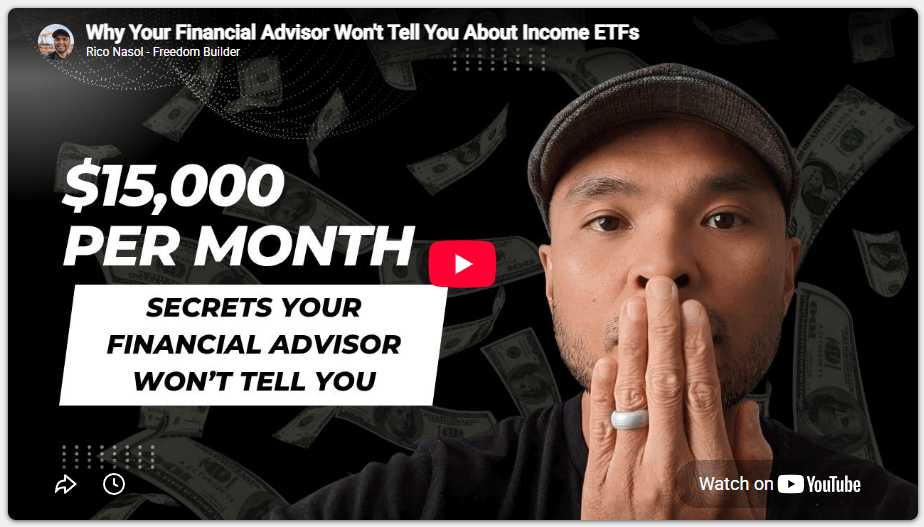
One question has been on my mind lately.
If there are ETFs paying 10%, 15%, even 30%+ annually in distributions, why aren't more financial advisors talking about them?
If you've followed this channel for a while, you already know I've built much of my income portfolio around these types of investments. Yet when I talk to other investors, I hear the same thing over and over: "My advisor never mentioned them."
So why is that?
I don't believe it's because these funds are scams or because they don't work. And this isn't meant to criticize financial advisors. Most advisors genuinely want what's best for their clients.
Instead, I think it comes down to how the industry works.
After digging into it, I realized there are three major reasons why many advisors rarely recommend these newer income-focused ETFs.
Reason #1: The Business Model Rewards Growth, Not Income
Let's start with the uncomfortable one.
Years ago, many financial advisors earned commissions for selling mutual funds. While that still exists, the dominant model today is Assets Under Management (AUM).
In simple terms, an advisor charges a percentage of the portfolio they manage—typically around 1% annually.
Here's an example.
Imagine you have a $1 million portfolio.
At a 1% advisory fee, the advisor earns about $10,000 per year.
Now imagine that portfolio doubles over the next decade by staying invested in broad-market growth funds.
Your portfolio becomes $2 million, and the advisor's annual fee doubles to $20,000.
Everyone wins.
But what happens if that same million-dollar portfolio is invested primarily in income ETFs that generate 10% annual distributions?
Instead of letting the portfolio compound, you're withdrawing approximately $100,000 every year to live on.
The portfolio may remain relatively flat—or even decline over time depending on market conditions and NAV erosion.
That also means the advisor's fee doesn't grow much either.
I'm not suggesting advisors are intentionally steering clients away from income strategies.
Far from it.
Most advisors are fiduciaries who genuinely care about helping their clients succeed.
But incentives matter.
When a business model rewards portfolio growth, it's natural that growth-oriented investments become the default recommendation.
It's not a conspiracy.
It's simply how the economics of the advisory business work.
Reason #2: Advisors Can't Always Buy the Same Funds Retail Investors Can
This was the biggest surprise for me.
As retail investors, we have incredible flexibility.
If a brand-new ETF launches today, I can log into Fidelity, Schwab, or another brokerage account and buy it within minutes.
Financial advisors often don't have that freedom.
Large firms like Morgan Stanley, Merrill Lynch, UBS, and many registered investment advisory firms have research committees and compliance departments that determine which investments advisors are allowed to recommend.
Most firms require funds to meet certain standards before they're approved.
That often includes:
Several years of operating history
Significant assets under management
Established performance records
Internal compliance review
Many of today's innovative income ETFs simply haven't been around long enough.
Covered-call ETFs...
Options-overlay strategies...
Tax-efficient structures using Section 1256 contracts...
Many of these products are only one to three years old.
That means an advisor might personally like the fund—or even own it in their own brokerage account—but still be unable to recommend it to clients because it hasn't cleared the firm's approval process.
Retail investors move quickly.
Large financial institutions move much more slowly.
That isn't necessarily a flaw.
Compliance exists to protect investors.
But one side effect is that innovation often reaches retail investors long before it reaches traditional advisory firms.
Reason #3: There's More Career Risk in Being Different
The final reason may simply be human nature.
There's an old saying on Wall Street:
"Nobody ever got fired for buying the S&P 500."
Think about what that means.
If an advisor recommends a broad-market index fund and the market falls 20%, clients usually understand.
Everyone knows the S&P 500.
Everyone has seen headlines about market downturns.
The conversation becomes:
"The whole market is down. Stay the course."
Now imagine a different scenario.
Suppose an advisor recommends a newer options-based income ETF.
The fund underperforms during a strong bull market or experiences more NAV erosion than expected.
Suddenly, the client asks:
"Why did you put me in this? I've never even heard of it."
Even if the strategy was appropriate...
Even if the math made sense...
Even if the distributions were exactly what the client wanted...
The advisor now carries much greater reputational risk simply because the investment was unfamiliar.
That's a difficult position to be in.
Sometimes the career risk of recommending something new outweighs the potential reward of being early.
What This Means for Investors
None of this means you should fire your financial advisor.
If you have an advisor who understands your goals, communicates clearly, and is transparent about how they're compensated, that's incredibly valuable.
In fact, I still believe professional advice has an important place.
Remember, I manage my income portfolio, but I also have retirement assets that benefit from long-term planning.
The point isn't to replace advisors.
The point is to become a better-informed investor.
Ultimately, your financial education is your responsibility.
Not your advisor's.
Not your broker's.
Not YouTube's.
Yours.
Why I Continue Researching Income ETFs
Over the past few years, I've discovered an entire ecosystem of income-focused ETFs designed to generate regular cash flow.
Some pay monthly.
Some pay weekly.
Some use covered-call strategies.
Others rely on options overlays or tax-efficient structures.
They aren't perfect.
I've made mistakes.
I've owned positions that didn't work.
I've sold funds at losses.
I've learned expensive lessons along the way.
But I've also built a portfolio generating more than $16,000 per month in passive income, and that journey came from doing my own research—not waiting for someone else to tell me what was available.
Every position, every adjustment, every lesson has helped shape the income snowball I'm building today.
Final Thoughts
I don't believe financial advisors are hiding these ETFs from investors.
I simply believe the industry they work within wasn't designed to adopt these strategies quickly.
That's an important distinction.
The investing world is constantly evolving.
New products appear every year.
Some succeed.
Some fail.
The responsibility falls on us to keep learning, ask questions, and understand the tools available.
Because every dollar has a job.
And sometimes the most valuable investment you can make isn't buying another ETF.
It's investing in your own financial education.
Book Flash Coaching Call Now.

Subscribe
Get early access to motivational emails, new content, and courses as soon as they arrive. I promise I won't send you anything else.


Contact Us
Feel free to get in touch with me at rico@riconasol.com
or book some time for us to chat by clicking here. Rico also coaches the greater Las Vegas and Henderson areas.
Open Hours
Mon - Fri: 9 AM – 6 PM
Saturday: Closed
Sunday: Closed
Location
Henderson, NV 89052
Email: rico@riconasol.com
Telephone: +1.702.900.7426

"Messy action is better than no action at all..." -Rico Nasol

Disclaimer: The Freedom Builder Bootcamp is for educational purposes only and does not constitute financial, investment, tax, or legal advice. Rico Nasol is not a registered investment advisor. All examples of specific funds or holdings are illustrations of the instructor's personal approach to his own money and are not recommendations. Investing involves risk, including possible loss of principal. Past performance does not guarantee future results. Consult a licensed professional before making investment decisions.
All Rights Reserved | Copyright Rico Nasol 2026 | Privacy Policy | Sitemap