


Leverage Builds Wealth. Debt crushes it.
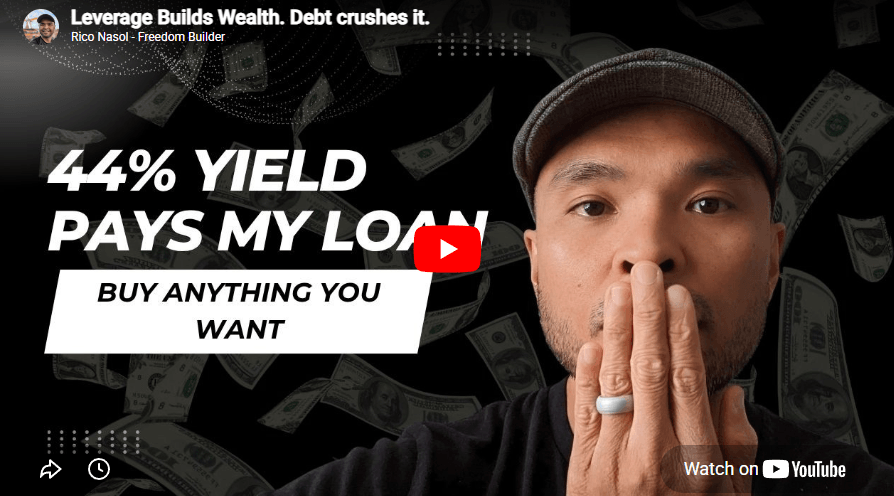
What if I told you there was a way to buy a truck and have the truck pay for itself?
I'm not talking about renting it out.
I'm not talking about a side hustle.
And I'm definitely not talking about some get-rich-quick scheme.
I'm talking about simple math.
The kind of math that most people never consider because they've been taught one financial rule their entire lives:
All debt is bad.
Recently, I purchased a Rivian R1T. I had enough cash to buy it outright.
But I didn't.
Instead, I put half down, invested the other half, and today that invested capital is generating more than $1,000 per month in passive income while my truck payment sits below $700.
The result?
The investment is effectively covering the payment while the principal remains invested.
That may sound controversial.
But once you understand the math behind it, it might change the way you think about money forever.
If you'd rather watch the full video, you can view the complete video here:
The Conventional Advice Isn't Wrong
For most of my life, if I wanted something, I paid cash.
That's what we're taught.
Avoid debt
Pay cash whenever possible
If you can't afford it, don't buy it
And honestly, that's good advice for many people.
It's saved countless families from financial stress and poor decisions.
But over time, I realized there's an important distinction that rarely gets discussed:
There's a difference between avoiding debt and understanding debt.
Not all debt serves the same purpose.
Some debt destroys wealth.
Other debt can help create it.
The challenge is knowing the difference.
My Relationship With Debt Wasn't Always Healthy
Before we go any further, it's important to understand where my perspective comes from.
In 2009, I filed for Chapter 13 bankruptcy.
That wasn't a financial theory.
That was my reality.
I lost my home.
I lost my car.
I lost virtually everything.
And unlike Chapter 7 bankruptcy, Chapter 13 doesn't simply wipe the slate clean.
It's a repayment plan.
You spend years paying back what you owe while living under strict financial oversight.
It was one of the most difficult periods of my life.
So when I talk about debt, I'm not speaking from a place of privilege or theory.
I've experienced firsthand what happens when debt is used irresponsibly.
That's exactly why I believe understanding debt matters.
Because the debt that put me into bankruptcy and the debt I'm using today couldn't be more different.
Bad Debt vs. Strategic Debt
Bad debt consumes.
Strategic debt produces.
That's the simplest way I can explain it
Bad debt often looks like:
High-interest credit cards
Consumer purchases without a plan
Borrowing money for things that immediately lose value
Money goes out.
Nothing comes back.
Strategic debt operates differently.
Money is borrowed at a relatively low rate and deployed into something that has the potential to generate returns above the cost of borrowing.
The goal isn't consumption.
The goal is creating a spread.
And that's exactly what I attempted to do with my truck purchase.
The Rivian Strategy
When I bought my Rivian R1T, I had enough cash to write a check for the entire vehicle.
Instead, I chose a different route.
I financed part of the purchase at approximately 5% interest and invested the remaining capital into a separate brokerage account.
The mission of that account is simple:
Generate enough income to cover the truck payment.
Nothing more.
Nothing less.
This isn't my primary portfolio.
This isn't my retirement strategy.
This is a purpose-built account with a specific job.
Every dollar inside it has a clearly defined purpose.
The Income Engine Behind the Payment
The account currently holds three high-yield income ETFs:
SEPY
CHPY
FEPY
These positions were selected because they generate substantial income through covered call strategies.
Again, this isn't how I structure my core portfolio.
In fact, I've been actively diversifying away from technology concentration elsewhere.
But this account has a different objective.
The goal isn't maximum diversification.
The goal is maximizing income generation.
As of this writing:
Account Value
Approximately $28,900
Unrealized Gains
Over $3,000
Total Gain
Approximately 13%
Projected Annual Income
$12,500+
Monthly Income
Roughly $1,050
The Truck Payment
Now let's compare that to the loan.
Monthly Payment
Approximately $672
Actual Monthly Payment
About $700 after additional principal payments
Interest Rate
5% APR
Remaining Balance
Approximately $31,000
Scheduled Payoff
October 2030
The math becomes very straightforward.
Monthly Income
$1,050
Monthly Payment
$700
Monthly Surplus
$350
That means the invested capital is generating enough cash flow to cover the payment and still leave excess income behind.
The truck gets paid.
The capital remains invested.
And the account continues working.
Understanding the Spread
Everything comes down to one concept:
The Spread
My loan costs approximately:
5%
The investment account currently yields approximately:
44%
Even if distributions were cut in half:
Yield drops to 22%
That would still be more than four times the borrowing cost.
That's the engine powering the strategy.
As long as the return meaningfully exceeds the cost of debt, the math remains favorable.
Of course, nothing is guaranteed.
There are real risks:
Distribution cuts
Market volatility
NAV erosion
Economic downturns
I've experienced all of those before.
This isn't risk-free.
But it's risk with a purpose and a defined objective.
Why This Isn't Gambling
Whenever leverage gets discussed, people immediately assume danger.
Sometimes they're right.
Leverage can absolutely be destructive.
But context matters.
I could have paid cash for the truck.
That distinction is important.
The strategy didn't depend on borrowed money I didn't have.
I wasn't hoping an investment would save me.
I wasn't stretching beyond my means.
I simply chose to keep capital working instead of locking it into a depreciating asset.
That's very different from overextending yourself.
True leverage begins from a position of strength.
Not desperation.
What Happens Next?
Let's fast-forward a few years.
The monthly surplus can be used for:
Additional principal payments
Reinvesting into the portfolio
Accelerating the payoff timeline
Eventually, the truck gets paid off.
But the investment account doesn't disappear.
The capital remains.
The income continues.
And now there's no payment attached to it.
At that point, the account can:
Be rolled into my main portfolio
Continue generating income
Fund another purchase
Compound further
The money does its job and keeps working afterward.
Wealthy People Use This Principle Every Day
The funny thing is that this concept isn't new.
It's simply how many wealthy individuals approach capital allocation.
Think about real estate.
Most investors don't buy rental properties with cash.
They:
Put money down
Finance the remainder
Allow rental income to service the debt
Keep the spread
Over time:
Debt declines
Equity grows
Cash flow continues
It's the exact same framework.
Different asset.
Same principle.
Borrow at one rate.
Earn at a higher rate.
Keep the difference.
The Real Mindset Shift
For years, my financial goal was simple:
Never owe anyone anything.
After bankruptcy, that felt safe.
But eventually I realized something.
Avoiding all debt isn't necessarily financial freedom.
Sometimes it's simply another limitation.
The version of me who filed bankruptcy borrowed money to consume.
The version of me today borrows money to produce.
Same tool.
Different purpose.
Different outcome.
And that mindset shift changed everything.
Final Thoughts
This strategy won't be right for everyone.
In fact, for many people, paying cash is still the better option.
But I think it's worth questioning the beliefs we've inherited about money.
Because sometimes the biggest obstacle to building wealth isn't a lack of capital.
It's an outdated understanding of how capital can be used.
The Rivian isn't the story.
The mindset is.
The truck simply became the vehicle—literally and figuratively—for putting that philosophy into practice.
And so far, the math is doing exactly what I hoped it would do.
Book Flash Coaching Call Now.

Subscribe
Get early access to motivational emails, new content, and courses as soon as they arrive. I promise I won't send you anything else.


Contact Us
Feel free to get in touch with me at rico@riconasol.com
or book some time for us to chat by clicking here. Rico also coaches the greater Las Vegas and Henderson areas.
Open Hours
Mon - Fri: 9 AM – 6 PM
Saturday: Closed
Sunday: Closed
Location
Henderson, NV 89052
Email: rico@riconasol.com
Telephone: +1.702.900.7426

"Messy action is better than no action at all..." -Rico Nasol

Disclaimer: The Freedom Builder Bootcamp is for educational purposes only and does not constitute financial, investment, tax, or legal advice. Rico Nasol is not a registered investment advisor. All examples of specific funds or holdings are illustrations of the instructor's personal approach to his own money and are not recommendations. Investing involves risk, including possible loss of principal. Past performance does not guarantee future results. Consult a licensed professional before making investment decisions.
All Rights Reserved | Copyright Rico Nasol 2026 | Privacy Policy | Sitemap