


State Street ETF Update: Why I Cut Three Funds and Doubled Down on My Winners
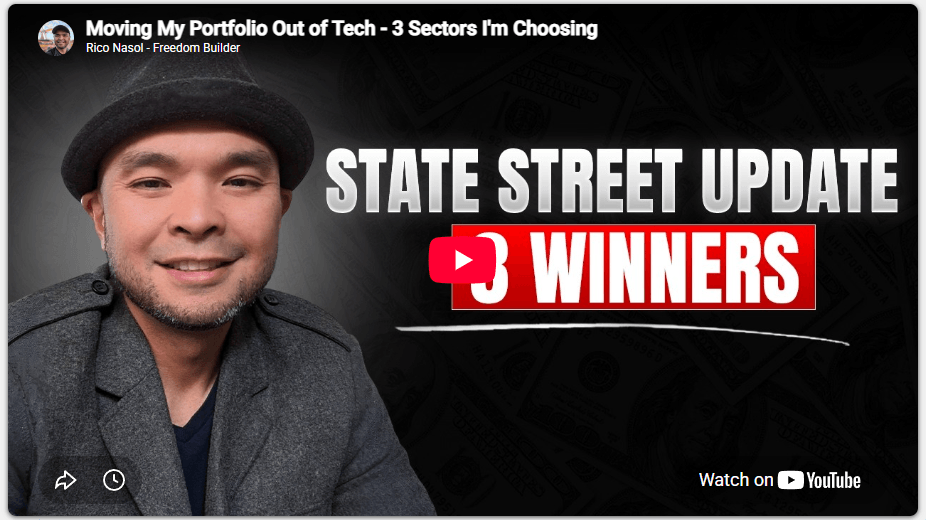
A couple of months ago, I launched an experiment.
I wanted to see whether State Street's sector-based premium income ETFs could help reduce my portfolio's heavy dependence on technology while continuing to generate meaningful income.
Today, the portfolio looks very different.
I've exited three of the original positions, tripled my investment in one that's currently down over 3%, and built a much more focused defensive allocation.
That might sound counterintuitive, but this wasn't about chasing price appreciation—it was about building long-term income.
Here's what changed, why I made those decisions, and how these positions now fit into my overall strategy.
Why I Started the Experiment
My income portfolio has long been concentrated in technology.
Funds like QQQI, SPYI, CHPY, and FEP have been tremendous income producers, but they all tend to move together whenever sentiment toward AI or semiconductors changes.
I wanted to build a defensive layer that generated income from sectors completely outside of technology.
To test that idea, I initially invested in five State Street sector income ETFs covering:
Energy
Utilities
Industrials
Materials
Healthcare
After several months of tracking both distributions and price performance, the results became clear.
When the Data Speaks, I Listen
The purpose of a test isn't to prove yourself right.
It's to collect data and let the results guide your decisions.
Some sectors simply failed to justify keeping my capital invested.
Industrials remained trapped in tariff uncertainty.
Materials struggled to gain momentum.
Healthcare never developed a meaningful catalyst during the testing period.
None of these were necessarily bad funds—they just didn't fit what I wanted my portfolio to accomplish.
Every dollar in my portfolio has a job.
Some of these dollars simply weren't doing theirs.
So I reallocated that capital into areas where I have much stronger conviction.
XLEI: My Highest Conviction Position
Energy has become my largest State Street position.
I currently own just over 1,000 shares, representing roughly $28,000 invested.
Ironically, shortly after I significantly increased my position, geopolitical tensions eased and energy prices pulled back.
As of this update, the position is down roughly 3%.
That doesn't bother me.
I'm not buying XLEI because I expect it to outperform over the next month.
I'm buying it because I expect it to serve my portfolio over the next several years.
When technology stocks struggle, energy often behaves very differently.
That's exactly the diversification I want.
This position serves as a long-term hedge against the concentration risk created by my technology-heavy income portfolio.
Even while the share price has declined, the ETF continues generating approximately a 20% annualized yield.
The distributions alone have already produced roughly $250 in income, steadily helping offset the temporary decline in capital value.
This is why I continue adding to the position through dollar-cost averaging.
XLUI: Utilities Continue Serving Their Purpose
Utilities have been a more complicated story.
Initially, this was my largest position within the State Street group.
After disappointing early performance, I decided to reduce my exposure.
That decision locked in approximately $500 in realized losses, but it also lowered my overall cost basis.
Today, the remaining shares have recovered and are now showing a modest unrealized gain.
Combined with more than $120 in distributions, the position continues doing exactly what I intended.
Utilities aren't exciting.
They aren't supposed to be.
People continue using electricity, water, and essential services regardless of economic conditions.
That's exactly why utilities belong in my defensive allocation.
XLSI: Stability Over Excitement
Consumer Staples became my newest addition after exiting the weaker-performing sectors.
This ETF owns companies people rely on every day.
Businesses like:
Procter & Gamble
Coca-Cola
Costco
Walmart
Whether the economy is booming or struggling, consumers continue buying groceries, household products, and everyday necessities.
The current yield is lower than my energy position—roughly 10% to 11%—but that's perfectly acceptable.
I'm not buying consumer staples for aggressive income.
I'm buying them for stability.
Sometimes boring investments perform the most important job in a portfolio.
My Defensive Portfolio Is Becoming More Focused
Instead of spreading capital across five sectors, I've narrowed my defensive allocation to three areas where I have the strongest conviction:
Energy
Utilities
Consumer Staples
Together, these positions represent roughly $45,000, or about 5% of my total portfolio.
This isn't diversification for diversification's sake.
Each sector serves a distinct purpose:
Energy helps offset technology concentration.
Utilities provide defensive stability.
Consumer Staples generate reliable income through nearly every economic cycle.
Since launching the experiment, these positions have already generated over $365 in distributions, even while portions of the market remained volatile.
That reinforces exactly why I built this defensive layer in the first place.
Building the Position Over Time
I have no intention of making large, one-time purchases.
Instead, I'm continuing to dollar-cost average into these positions gradually.
This isn't something I'm trying to build overnight.
It's a long-term project.
My aggressive income portfolio will continue doing the heavy lifting through technology-focused funds.
These defensive positions simply provide another source of income that isn't dependent on AI, semiconductors, or the next earnings report from Nvidia.
Looking ahead, I'm still interested in adding healthcare exposure through XLVI, but only when the timing makes sense.
Healthcare remains an area I believe belongs in a diversified income portfolio.
I'm simply waiting for the right opportunity.
Final Thoughts
This experiment reminded me of something every investor eventually learns.
Successful investing isn't about proving your original thesis.
It's about being willing to adjust when the data tells a different story.
I tested five funds.
Three didn't earn a permanent place in my portfolio.
The remaining three did.
That's exactly how investing should work.
Every position should have a clear purpose.
For me, these ETFs aren't designed to outperform technology during bull markets.
They're designed to keep my income snowball rolling when technology eventually slows down.
And that's a role worth paying for.
Book Flash Coaching Call Now.

Subscribe
Get early access to motivational emails, new content, and courses as soon as they arrive. I promise I won't send you anything else.


Contact Us
Feel free to get in touch with me at rico@riconasol.com
or book some time for us to chat by clicking here. Rico also coaches the greater Las Vegas and Henderson areas.
Open Hours
Mon - Fri: 9 AM – 6 PM
Saturday: Closed
Sunday: Closed
Location
Henderson, NV 89052
Email: rico@riconasol.com
Telephone: +1.702.900.7426

"Messy action is better than no action at all..." -Rico Nasol

Disclaimer: The Freedom Builder Bootcamp is for educational purposes only and does not constitute financial, investment, tax, or legal advice. Rico Nasol is not a registered investment advisor. All examples of specific funds or holdings are illustrations of the instructor's personal approach to his own money and are not recommendations. Investing involves risk, including possible loss of principal. Past performance does not guarantee future results. Consult a licensed professional before making investment decisions.
All Rights Reserved | Copyright Rico Nasol 2026 | Privacy Policy | Sitemap